
Workshop – EUCNC 2025, Tuesday 4 June, Poznań
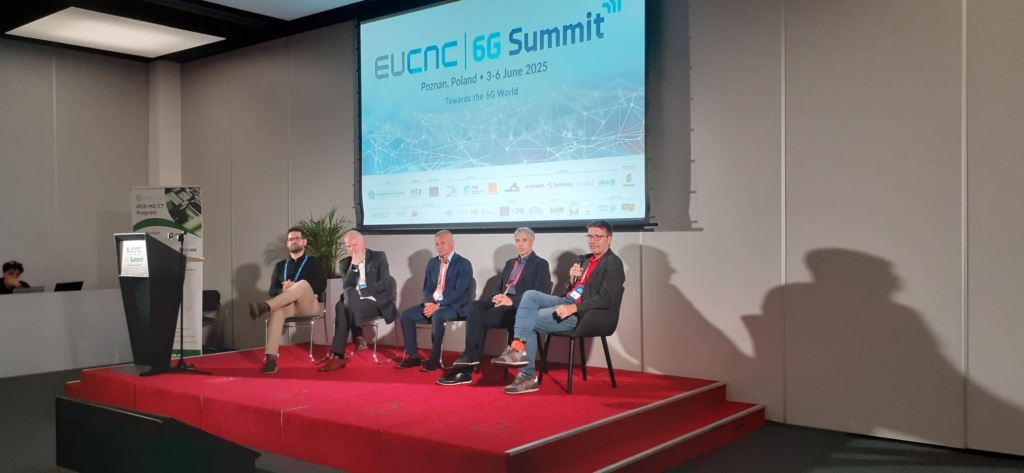
The IPCEI ME/CT & Next-Gen Networks workshop provided a strategic overview of Europe’s efforts to build leadership in semiconductor technologies and future connectivity systems. The event brought together leading industrial players and researchers contributing to the IPCEI ME/CT Communicate workstream. The session demonstrated how innovation in substrates, open hardware, photonics, and high-frequency testing is converging to support the development of secure, sustainable, and AI-native 6G infrastructures.
Workstream COMMUNICATE focuses on the research on and development of novel sensors to collect data necessary for understanding the environment, deciding on actions, and validating that these actions have the intended effect. This work will be completed by the development and application of advanced measurement and testing procedures to ensure performance, lifetime, safety and security of the newly developed components and systems.
The 2025 EuCNC & 6G Summit builds on putting together two successful conferences in the area of telecommunications: EuCNC (European Conference on Networks and Communications), supported by the European Commission, and the 6G Summit, originated from the 6G Flagship programme in Finland, one of the very first in its area. The conference is sponsored by the IEEE Communications Society (ComSoc), the European Association for Signal Processing (EURASIP) and the European Association on Antennas and Propagation (EurAAP), and focuses on all aspects of telecommunications ranging from 5G deployment and mobile IoT to 6G exploration and future communications systems and networks, including experimentation and testbeds, and applications and services.
It brings together cutting-edge research and world-renown industries and businesses, globally attracting in the last years more than 1000 delegates from more than 40 countries all over the world, to present and discuss the latest results, and an exhibition with more than 50 exhibitors, for demonstrating the technology developed in the area, namely within research projects from EU R&I programmes.
Overview of IPCEI ME/CT & Workstream Communicate & Strategic importance of Europe’s semiconductor-driven connectivity
Speaker: Stefan Wunderer – Nokia
Stefan Wunderer opened the session by outlining the scope and ambition of IPCEI ME/CT and its Communicate workstream. With over €22 billion in total investment and more than 130 partners, IPCEI ME/CT is the largest European initiative ever launched in microelectronics. The Communicate stream supports software-defined, AI-native, and energy-efficient radio platforms operating at 6–8 GHz. Nokia’s involvement includes a €360 million investment in Germany to accelerate sustainable and sovereign innovation in next-generation connectivity systems.
What’s Powering the 6G Revolution?
Speaker: François Brunier – Soitec
François Brunier presented Soitec’s latest engineered substrate platforms designed to meet the performance and efficiency demands of future 6G networks. The RF SOI and sSOI families target Satcom and D-band applications, offering excellent linearity and thermal management. SmartGaN is introduced as a scalable, sustainable alternative to GaAs for FR2 and FR3. InPOSi (InP-on-Silicon) combines THz performance with CMOS compatibility and cost efficiency. These technologies position Europe at the forefront of advanced materials for 6G infrastructure.
The Key to sub-THz? Smarter Testing
Speaker: Frank Groeger – Rohde & Schwarz
Frank Groeger detailed Rohde & Schwarz’s efforts to enable sub-THz communication through cutting-edge test and measurement solutions. Under the GANYDEM170 IPCEI project, R&S develops European GaN-based solutions for D-band systems. Their involvement in 6G-TERAKOM and 6G-ADLANTIK includes the creation of waveguide switches, photonic THz generators, and over-the-air setups for beamforming and SoC validation. These technologies are key for enabling standardization and industrial adoption of THz communications.
RISC-V in Europe’s 6G Plans
Speaker: Ivan Rodero – Openchip & Software Technologies
Ivan Rodero emphasized the importance of open hardware architectures in future 6G systems. As part of Openchip’s contribution to IPCEI ME/CT, the work focuses on building RISC-V-based platforms to enable low-power processing, real-time performance, and secure communication infrastructure. This approach aligns with the EU’s goal to reduce dependency on proprietary IP cores and reinforce digital sovereignty.
Smarter Sensing with HyperPIC?
Speaker: Ryszard Piramidowicz – Vigo Photonics
Ryszard Piramidowicz introduced HyperPIC, Vigo Photonics’ platform for mid-infrared photonic integrated circuits (MIRPIC). Built on InP, GaSb, and Ge-on-Si, the platform supports sensing and communication in the 3–5.5 µm range. It includes a full library of photonic components (MMI, AWG, grating couplers, QCLs, detectors) and aims at industrial applications such as breath analysis and free-space optical transmission. Supported by the IPCEI ME/CT, HyperPIC contributes to establishing a European MIR photonics supply chain.
Useful Links & Further Information :
- EuCNC & 6G Summit 2025: https://www.eucnc.eu
- 6G Flagship: https://www.6gflagship.com
- IEEE Xplore Digital Library: https://ieeexplore.ieee.org
- Workstream COMMUNICATE: https://ipcei-me-ct.eu/communicate/