Relive the IPCEI ME/CT CONNECT 2025 Workstreams Presentations
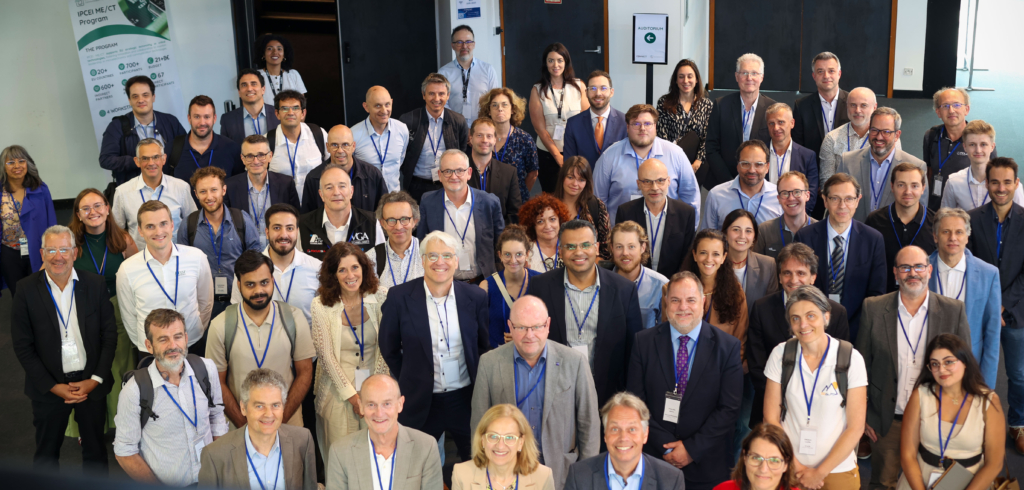
On June 16, the first edition of IPCEI ME/CT CONNECT took place in Grenoble. At the core of the programme, the four Workstreams structure the initiative around the fundamental functions of microelectronics: SENSE, THINK, ACT and COMMUNICATE. Each of these domains was presented during the event, with detailed insights from industrial leaders. The replays of these sessions are now available.
The SENSE workstream focuses on capturing information from the environment, integrating new sensor principles, embedded AI and sensor fusion for domains such as automotive, health, industry and aerospace. ams OSRAM presented its broad portfolio of optoelectronic solutions, from LEDs and µLEDs to advanced sensors and optical modules. Their work emphasises miniaturisation, in-plane sensing capabilities, and integration of µLED displays with embedded sensor functions, opening the way to AR/VR and medical monitoring. STMicroelectronics detailed the VD1940 hybrid RGB-IR image sensor, designed for Driver and Occupant Monitoring Systems (DMS/OMS). This 5.1 Mp device combines high sensitivity, cybersecurity features such as cryptographic authentication, and is already in mass production to comply with EU GSR2 road safety regulation. VIGO Photonics introduced HyperPIC, the first Mid-IR photonic integrated circuit platform, enabling molecular detection with up to 1000x stronger absorption lines than NIR/SWIR. The technology supports applications from CH₄ and CO₂ leak detection to biomedical monitoring and free-space optical communication, backed by the development of a complete in-house and foundry manufacturing infrastructure.
The THINK workstream addresses energy-efficient and secure data processing and storage. Mycroft Mind presented an embedded AI solution for predictive sensing at the edge. Instead of sending raw data to the cloud, the sensor integrates incremental learning algorithms, autonomously modelling expected behaviour and detecting anomalies in real time. This reduces latency from hours to milliseconds, lowers dependence on cloud infrastructure, and enhances resilience in industrial environments. STMicroelectronics showcased its roadmap from embedded phase-change memories (PCM) at 18 nm FDSOI to RFID sensors. By reducing the bill of materials and integrating NFC/RFID architectures, ST enables low-cost, scalable IoT solutions. Concrete use cases include healthcare monitoring (body temperature, glucose), agriculture (soil moisture, irrigation), automotive (tire pressure), and structural health monitoring.
The ACT workstream transforms electronic signals into physical actions, contributing directly to Europe’s green transition. Infineon presented the scope of ACT, from advanced Si and SiC power modules to smart pixel technologies and gesture recognition. Soitec gave a deep technical presentation of SmartSiC™, an engineered SiC substrate manufactured with SmartCut™ technology. The platform delivers significant performance gains: improved power cycling robustness, reduced bipolar degradation, lower conduction and switching losses, and faster transition to 200 mm wafers. Independent evaluations showed up to 13% efficiency gains at high current density and a CO₂ footprint reduction by a factor of four compared to bulk SiC.
The COMMUNICATE workstream develops high-performance and secure communication technologies for 5G/6G, edge computing and IoT. Soitec highlighted material and design approaches to increase bandwidth and reduce latency, enabling embedded AI functionalities in communication systems. MEMC presented the integration of uncertainty estimation in AI classification models for defect detection in semiconductor manufacturing. This approach addresses the “black box” problem by providing explainable and trustworthy AI, aiming for zero-defect wafer production. GlobalFoundries detailed the EUROFOUNDRY project, centred on its Dresden site with 880,000 wafers/year capacity. Technologies presented included RF/mmWave, eNVM, and power management platforms, targeting automotive radar, secure communication chips and energy-saving semiconductors. The project also integrates sustainability with water recycling, photovoltaics and combined heat and power installations.
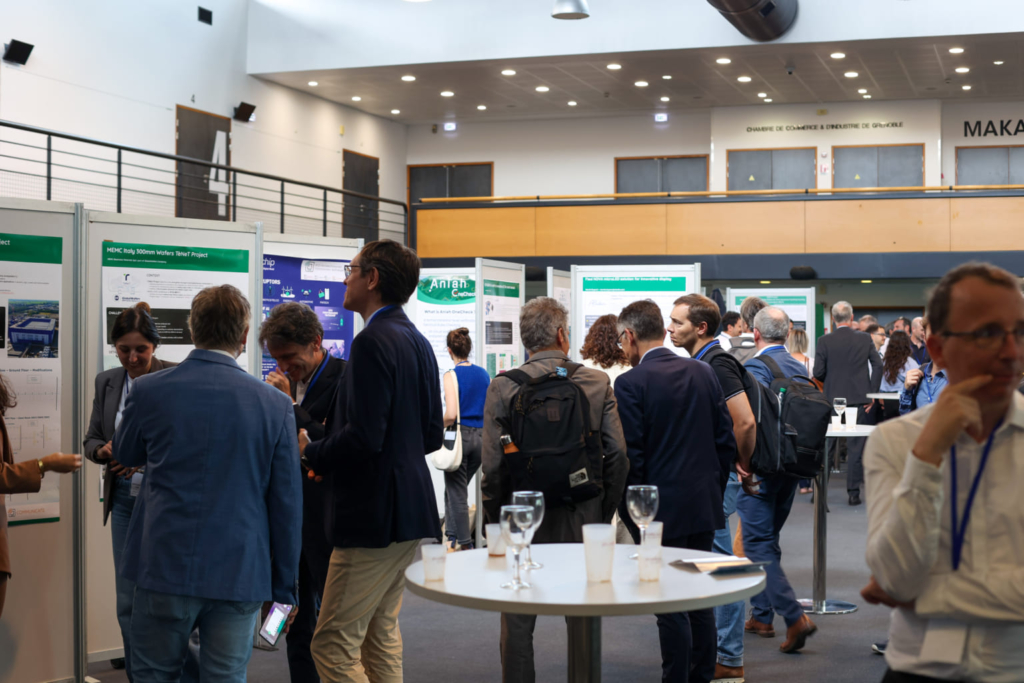
In addition to these technical sessions, the CONNECT event hosted 22 posters illustrating ongoing R&D across the four Workstreams, from materials and packaging to system-level applications. These sessions enabled rich exchanges between researchers, SMEs and industrial partners. Networking opportunities throughout the day reinforced the collaborative spirit and strengthened the European ecosystem.
It was a great event in a great place, organised by a great team, with great outcomes for the European semiconductor industry. All stakeholders in the European semiconductor industry participated in this event. It provided the perfect opportunity to share our understanding of the challenges ahead and consider future solutions that the European industry will develop. Let's maintain the momentum! The poster session was extremely valuable for encouraging discussion and networking.
Stefan Landis, MERCK Group
The IPCEI ME/CT CONNECT 2025 event has shown how the four Workstreams form the backbone of IPCEI ME/CT, linking sensing, processing, action and communication into an integrated value chain. The next major rendez-vous will be the IPCEI ME/CT Annual Forum in The Hague end of November 2025, followed by the next IPCEI ME/CT CONNECT edition in summer 2026.