
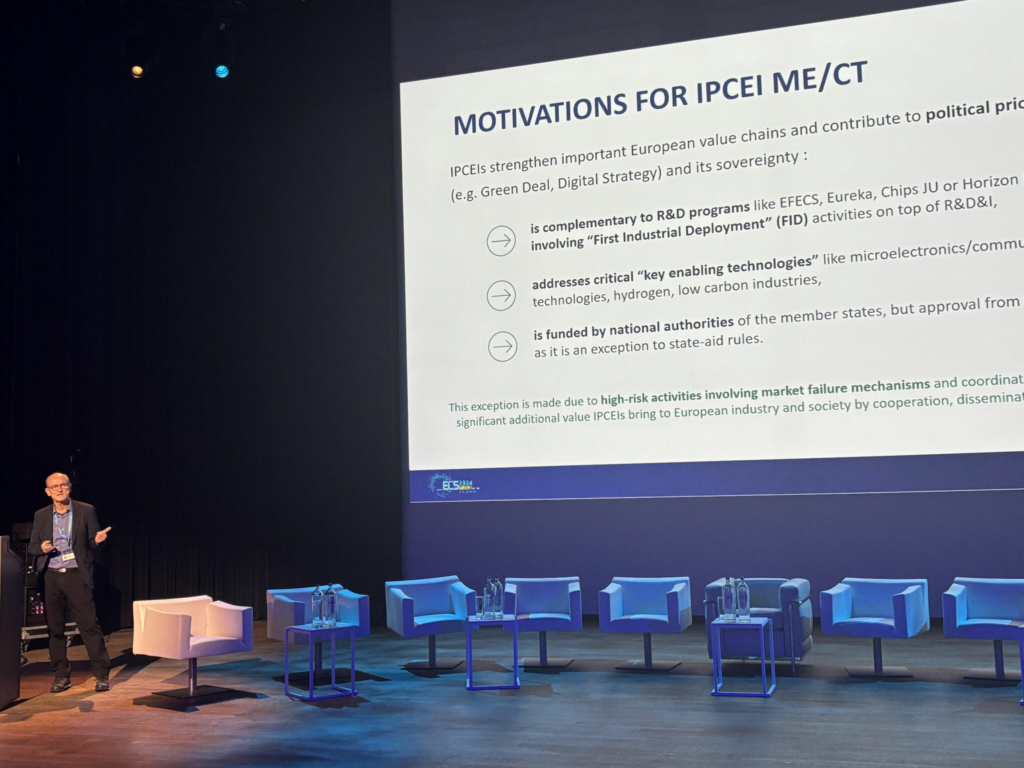
The IPCEI ME/CT initiative took center stage at EFECS 2024, with Ferdinand Bell, a member of the Transformers Group, delivering an engaging presentation on the program’s vision and achievements. Focused on enhancing Europe’s position in microelectronics and communication technologies, Bell’s talk highlighted how this initiative is shaping a sustainable and competitive future for the European Union.
What is EFECS?
EFECS, or the European Forum for Electronic Components and Systems, is a leading conference dedicated to fostering innovation, collaboration, and growth within the electronics industry. Held from December 5 to 6, 2024, at the ICC Ghent convention centre in Belgium, it brings together experts, industry leaders, policymakers, and researchers to discuss the latest advancements and challenges in microelectronics and communication technologies. This annual event serves as a central platform for sharing knowledge, networking, and driving forward European leadership in these fields.
Why IPCEI ME/CT Matters
Important Projects of Common European Interest (IPCEIs) represent a significant contribution to economic growth, jobs, the green and digital transition, and competitiveness for the Union’s industry and economy. They bring together knowledge, expertise, financial resources, and economic actors across the Union, creating positive spillover effects for the entire region.
The IPCEI ME/CT project is a collaborative effort to strengthen European value chains while addressing major societal and industrial challenges. Think of it as Europe’s way of uniting diverse industries and researchers to tackle global challenges, like reducing carbon emissions or making our technology more energy-efficient. With projects like this, Europe aims to lead the way in creating innovative solutions that benefit everyone, from researchers in labs to companies bringing products to market. Aligned with key priorities like the Green Deal and Digital Strategy, the program bridges the gap between research and development and "First Industrial Deployment" (FID). It focuses on critical enabling technologies such as microelectronics, low-carbon industries, and battery technologies.
As Bell explained, IPCEIs are designed to address market failures, foster collaboration, and create spillover benefits that extend beyond individual participants. To put it simply: this initiative doesn’t just aim to develop new technologies, it wants these innovations to ripple outwards, creating opportunities across the entire European economy. The ME/CT initiative is the largest IPCEI to date, with €22 billion in investments, including €8 billion in public funding and €14 billion from private contributors.
The Role of the Transformers and Facilitators Groups
A key factor in the program’s success is the work of the Transformers Group (TG) and the Facilitators Group (FG). These teams ensure that the program’s ambitious goals are met effectively and with maximum impact:
- Transformers Group (TG): The TG focuses on driving collaboration, increasing the impact of the program, and envisioning the future of European microelectronics. By connecting different workstreams and stakeholders, the TG helps align efforts across the entire initiative.
- Facilitators Group (FG): The FG acts as the industrial interface with public authorities. It ensures that workstream results are reported accurately, coordinates communication with the Public Authority Board (PAB), and shares technical achievements during General Assembly meetings.
The Four Workstreams: Building Blocks of Innovation
Together, these groups support the four individual workstreams (SENSE, THINK, ACT, and COMMUNICATE) that form the backbone of the IPCEI ME/CT program. Each workstream is tailored to address a specific stage of the microelectronics value chain, ensuring Safety & Security, Sustainability, and Digital Sovereignty for Europe:
- SENSE: Focuses on developing advanced sensors to gather critical environmental and operational data.
- THINK: Aims at creating energy-efficient processors and secure data storage solutions.
- ACT: Centers on power systems and technologies that transform data into tangible actions.
- COMMUNICATE: Innovates in data transmission, ensuring seamless connectivity between systems.
These interconnected workstreams act like different pieces of a puzzle, each playing a role in creating a full picture of innovation. By addressing specific stages of how data is sensed, processed, transmitted, and acted upon, these workstreams ensure Europe can create smarter, more efficient, and more sustainable technologies.
The Importance of Spillover Activities
Spillover activities are a cornerstone of the IPCEI ME/CT initiative, ensuring that its benefits extend beyond the immediate participants and sectors. These activities create opportunities for knowledge sharing, collaboration, and innovation across the European Union. By fostering connections between industries, academia, and policymakers, spillovers help amplify the program’s impact, driving progress in areas such as sustainability, digital transformation, and strategic autonomy.
Key examples of spillover activities include:
- Educational Outreach: Engaging over 200 PhD and Master’s students, as well as 130 interns, to build a skilled workforce for Europe’s future.
- Networking Events: Organizing over 200 events, such as the Semiconductor Rendezvous in Prague, which bring together stakeholders from across Europe to share insights and forge partnerships.
- Technological Dissemination: Sharing research findings and advancements through open events and collaborations, ensuring that innovations benefit the wider ecosystem.
Put simply, spillover activities make sure the benefits of this initiative aren’t kept in a bubble. They spread knowledge, skills, and opportunities throughout Europe, ensuring that the results of the program are felt by industries, communities, and individuals far beyond the direct participants.
Summary of Progress in 2024
As the IPCEI ME/CT project approaches the end of its current phase, its achievements have surpassed initial expectations:
- Key Performance Indicators: All project KPIs have been overachieved, highlighting the success of the initiative.
- Patent Applications: Close to 1,000 patents demonstrate the program’s innovative impact.
- Job Creation: Hiring efforts have reached high four-digit numbers, creating opportunities across Europe.
- Education and Training: Over 200 PhD students, 130 internships, and numerous training programs have fostered a new generation of skilled professionals.
- Collaborative Network: The program has built a tightly connected ecosystem, with spillover effects extending beyond direct participants.
- Public Impact: More than 200 open events and collaborations have made the initiative’s advancements accessible to wider audiences.
What’s clear is that the IPCEI ME/CT is more than just a technical program, it’s a catalyst for change, setting the stage for Europe to take a leading role in the technologies that define our future.
Looking Ahead
Bell emphasized the need for continued collaboration to ensure Europe remains competitive in the global microelectronics industry. Events like the upcoming Semiconductor Rendezvous in Prague and various educational conferences are key to maintaining momentum and strengthening partnerships.
Discover More
Want to learn more about IPCEI ME/CT and Ferdinand Bell’s presentation? The full presentation is now available on our website below, offering deeper insights into how this initiative is paving the way for a sustainable, secure, and digitally sovereign Europe.